
MV Weekly Market Flash: Surprise!...

Well, this was one of those weeks. We had the idea of digging into the good and the bad of China’s economy for our commentary this week, giving our readers a break from All Bonds All The Time, but the bond market said, sorry, no can do. China will have to wait.
As the week got underway, yields on US Treasuries were close to their recent decades-long highs. On Wednesday morning, the September Consumer Price Index was released, and it came in on the hot side, with headline inflation jumping to an annual rate of 3.7 percent while core CPI, minus the volatile categories of energy and food, rose to a 2.6 percent year-on-year rate. In a matter of minutes after the CPI report release, Treasury yields jumped by double digits. Here we go again, we thought.
Defying Expectations
Guess again. Before the stock market even opened for the day, bonds performed a spectacular turnaround, with yields heading down and pretty much everyone in the financial chattering class wondering why Treasuries were rallying on the news of higher inflation.
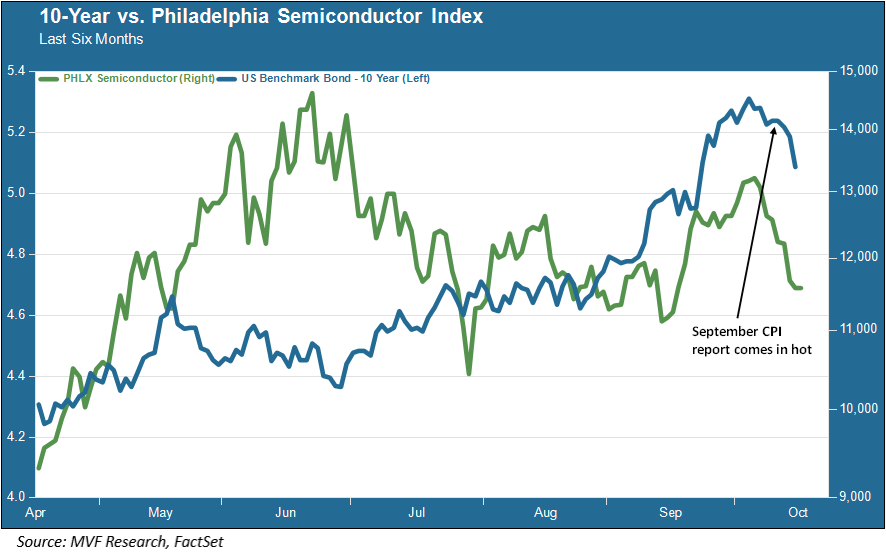
The rally continued into Thursday’s trading (remember that a fall in yields means that bond prices are going up). Thursday morning saw the release of another inflation report, this the Producer Price Index that measures price changes in the wholesale sectors of the economy. This was another blistering report, showing that prices upstream from consumers rose by 1.3 percent in the month of September for an annual increase of 6.3 percent. Like the CPI report, the PPI number was well ahead of economists’ expectations. By the end of it all, though, the 10-year US Treasury yield had dropped around 0.22 percent from its recent high, reflecting a percentage change of more than four percent. That’s a big change for what is supposed to be the closest thing the world has to a risk-free asset.
Bonds Just Wanna Be Bonds
In fact, the bond market this week was doing, for what seems like the first time in a very long while, what the bond market is supposed to do. Because the other big thing that was happening in financial markets this week was that, over in the stock market, the AI infrastructure trade was getting hammered again after a couple months of relative calm. The Korea Kospi index, roughly half of which is made up of the two memory chip companies Samsung and SK-Hynix, started dropping on Monday and by Thursday was more than 16 percent lower than where it started the week (it rallied a bit to close out the week in Friday trading). US AI-centric names followed suit, as seen in the downward trajectory of the Philadelphia Semiconductor Index shown in the chart above.
What appears to be going on, then, is that in the tension between bonds as an expression of worries about inflation, debt, crowding out from the corporate market and all the other problems we have been writing about so much in the past few weeks, and as a safe haven in times of general economic angst, the safe haven role still can come out on top. The market jitters are not limited to the AI theme. Retail sales numbers also came out this week, and while the headline number was positive, the main source of growth was from gas stations – in other words, the significantly larger amount of money motorists are shelling out at the pump. That is not what one would call a healthy signifier of retail activity. Additionally, there are signs that dampening consumer activity is starting to trickle up into better-off segments of the household economy. The vaunted K-shape so beloved by economists seems to be losing some heft on the upward-sloping diagonal of that K.
We do not think the tension we noted above has gone away. Yields will continue, we believe, to experience pressures from both the upward impulse of inflation and related worries, and the downward movement resulting from investors seeking a safe haven. We are happy in one sense to see that bonds can still perform that function. We’re a bit less sanguine, though, about where it may be pointing.