
MV Weekly Market Flash: The...

The monthly jobs report from the Bureau of Labor Statistics will come out in two weeks from today. Do you want to hazard a guess as to the number of nonfarm payroll (NFP) gains reported for the month of April? Good luck with that – see below.
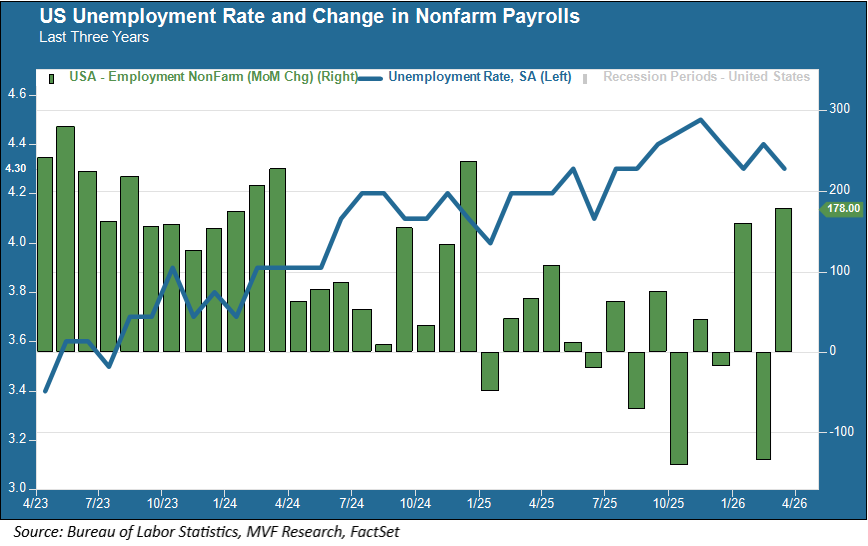
In the past fifteen months we have had nine months of payroll gains and six months of payroll losses, according to the BLS data. And this chart doesn’t reflect an even more bizarre facet of the BLS report, in which initial estimates are subject to sweeping revisions. Case in point: the initial report for February 2026 had nonfarm payrolls declining by 92,000. A few weeks later, that number was revised to payroll losses totaling 133,000. Who knows what that March NFP figure of 178,000 gains will look like when the BLS gives us a revision in its next release on May 8?
Below the Headlines
All the payrolls volatility notwithstanding, the headline numbers themselves are not flashing five-alarm warnings. The unemployment rate, which has bounced around between 4.0 and 4.5 percent since the beginning of last year, is nowhere close to the levels normally associated with economic downturns (though that can change quickly when exogenous factors impact prior assumptions about growth trends). At least one industry sector – healthcare – is a reliable enough job creation machine to offset steadier losses in other sectors like manufacturing and transportation services.
Below the headlines, though, there are plenty of indications that things are moving in the wrong direction. Fed chair Jay Powell is of the opinion that net job creation is effectively zero, which does not look too different from that chart above showing nearly offsetting NFP gains and losses from month to month. The situation for entry level jobs is even worse. The unemployment rate for recent college graduates (age 22-27) is around 5.6 percent, higher than the overall figure of 4.3 percent and well above the 3.1 percent level for all college graduates. Anecdotal evidence from young job seekers paints a hellish picture of thousands of resumes and cover letter sent into the void of employment search platforms, never to be heard from again. Graduate degrees in areas once thought to be sure-fire recipes for successful careers are not the golden ticket that was supposed to be worth that $100,000-plus investment in one’s education.
The Specter of AI
Looming over all the present uncertainty in the labor market is the specter of artificial intelligence. Don’t take it from us – listen to what the experts in the field themselves have to say. Dario Amodei, the CEO of Anthropic, opined recently that roughly 50 percent of entry-level white collar jobs are at risk of disappearing within a one to five year time frame, potentially creating an unemployment spike as high as 20 percent. The most exposed industries, according to Amodei, are those very ones that attract the brightest and most ambitious cohort of young people – finance, consulting, law and tech.
OpenAI, Anthropic’s peer and rival in the AI space, projects that 18 percent of all jobs will soon be automated with AI capabilities. A recent CNBC study found that AI-related layoffs totaled 55,000 in 2025. Every day we see evidence of major layoffs at tech firms – this week it was Meta (10 percent reduction to “offset” spend on AI) and Microsoft (voluntary redundancy of 7 percent) in the headlines.
Of course, for every AI Cassandra warning of the crisis ahead there is a Pollyanna pointing to the long history of doomsaying at the dawn of new technologies that proves overblown. This time, though, there may be more reason to pay attention to the Cassandras than to blithely assume that new doors will open for each one shut by the incursion of AI. The technology is growing and spreading and becoming more sophisticated at a mind-blowing rate. Not just here at home, either. China’s DeepSeek platform, which caused a major freak-out in the AI space early last year when it debuted, appears to be closing in on the capabilities of the leading US models. So there is a geopolitical element overlaid on what could be one of the biggest macroeconomic shake-ups ever experienced in our country. Regulators, policymakers and business leaders need to be ready to take up the challenge. As do the rest of us.