
MV Weekly Market Flash: FOMO...

Summertime, and the living is…easy? Maybe not so much. soporteprofit.com ppid.pnk.ac.id The idea of the month of August being a beach-read lull between midsummer and the frenzy of back to school seems to have gone the way of dial-up Internet. albseriale.cc Nope, there are more crises and scandals and natural disasters clamoring to be the top headline on any given day than there used to be in the space of a month – or so it seems, at least. It’s a lot for anyone to take in – including those of us trying to make sense of investment markets
Breaking Out of the Holding Pattern
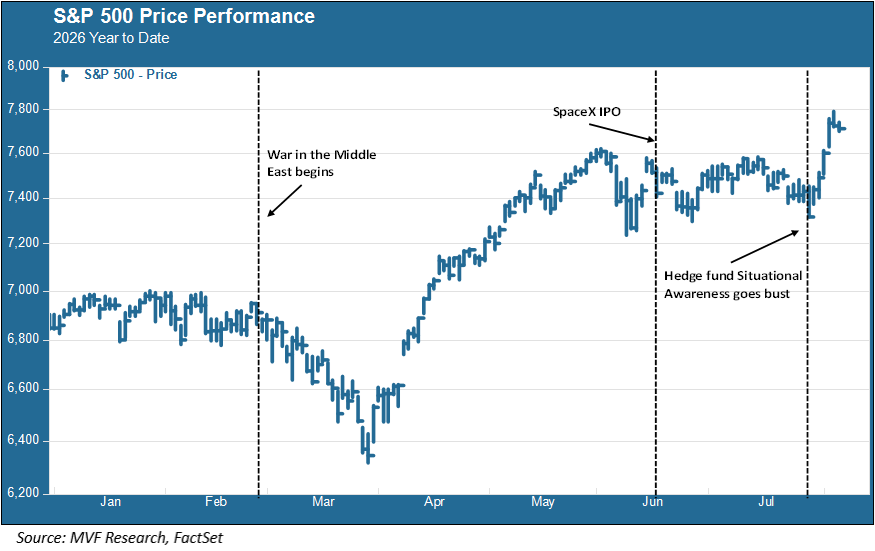
Up until this week, US stock indexes had been in something of a holding period pattern since the middle of June. Markets had rallied strongly once the initial reaction to the Middle East war wore off, gaining around 20 percent from the end of March to the beginning of June. Then, a relatively strong jobs report threw some cold water onto sentiment – strong jobs equating to no Fed rate cut in the market’s hive mind. Overall conditions stabilized, but things in the hitherto-dominant AI trade started getting wonky right around the time that SpaceX came to market in the middle of June. Maybe the idea of a company valued at 95 times top line sales was a bridge too far even for the usually credulous Mr. Market. Just speculating here. Anyway, wild day-to-day gyrations among the major AI-themed stocks, with vast high-low spreads, became the norm as the S&P 500 mostly lurched along sideways.
At least our blue-chip index has some protection from other industry sectors. Not so the South Korean Kospi index, about half of which is dominated by two semiconductor stocks, Samsung Electronics and SK-Hynix. That index saw a precipitous drop of 39 percent from its mid-June high to the end of July. Stories abounded of young Korean investors, trying to stay ahead of punitive cost of living conditions and a weak job market in that country, getting wiped out by ill-timed bets on what had been the hottest national market of 2026.
But it was not only retail punters who got smacked by the AI trade backlash during this period. Here at home, a hedge fund called Situational Awareness, run by a 24-year old German wunderkind named Leopold Aschenbrenner, made the news right at the end of last month with the announcement that its public equity portfolio had gone pear-shaped, losing 67 percent in the space of that month and being forced to sell off its positions in a fire sale to Ken Griffin’s Citadel. Situational Awareness encapsulated the FOMO of the AI trade, with eye-popping returns juiced by leverage of four times or more. So much harder, the fall to earth with that much debt.
The Push and the Pull
The market appeared to breath a huge sigh of relief when the news about Situational Awareness broke, and for a couple days the AI-momentum trade reverted to its old FOMO-ish ways, as seen in the chart above. But the bullish impulse has some headwinds to deal with, in the form of an unforgivingly high earnings bar. Case in point: Sandisk Corporation, a maker of storage devices and solutions based on NAND flash technology, has been one of the highest-flying constituents of the AI trade, with a year-to-date gain of over 800 percent (not a typo) to its mid-June peak (it subsequently fell by around 560 percent to its low on July 29 and was a prominent name in the Situational Awareness portfolio, hence the carnage there).
Sandisk released its quarterly earnings report today, blowing away analyst expectations as it reported a 372 percent increase in top line sales and 13-fold growth in earnings per share, along with a raised outlook affirming the continued insatiable demand for its products and services. Not good enough, say investors, and the stock is down 5 percent as we write this towards the end of the trading day on Thursday.
Sandisk may be an extreme case, but it typifies the push-pull sentiment in the market right now. The animal spirits of FOMO are still plentiful – the bulls really want to run. But the earnings bar is high enough to require a talented pole vaulter to get over it. It is a fragile balance. The big question is what happens when we get to that devilishly tricky period that often sets in after Labor Day – and we are just about a month away from finding out.