
MV Weekly Market Flash: Where...

On the face of it, this doesn’t seem like it should be a week to be worrying too much about what’s going on in the markets. The S&P 500 achieved another record high on Tuesday, and is hovering just below that level as trading gets set to kick off on what, for the moment at least, has the potential to be another up day. The bond market, where many of our worries recently have been focused, has been marching to a somewhat strange rhythm in which yields rise by a few basis points in the morning and then settle down as the day wears on. A couple successful Treasury auctions, together with a lack of much new news, has kept a lid on those pesky yields at the long end of the Treasury curve. Meanwhile, while oil prices certainly have not come down in any meaningful way, they have remained relatively calm in the face of several poignant bouts of renewed hostilities between parties in the ever-spreading Middle East war.
The problem is that things don’t feel calm. There is a sense among market participants that a bunch of tripwires are out there, any one of which could be triggered and set off a nasty set of reactions throughout the market. Nobody really knows where these tripwires are. Let’s consider a couple of possibilities.
Six Is the New Five
In the Treasury market, the tripwire most often invoked is the yield beyond which lie monsters. Where is that yield? A year ago, when the 10-year note was trading around four percent, there was some speculation that things would start to unravel when the yield crossed the five percent threshold. Well, that happened, and no monsters to speak of. The 10-year has traded above five percent each and every day since September 23, is currently at around 5.25 percent and touched a 22-year high in early trading yesterday. That’s not great, to be sure, because the benchmark 10-year Treasury impacts every other variety of fixed income securities including home mortgages and auto loans. But – see above – it has not sent stock prices tanking in the way pundits were opining a year ago.
So then, is six percent the tripwire number? Maybe and maybe not, but there is a good reason why observers are increasingly of a mind that the tripwire is out there, somewhere. The composition of investors who hold Treasuries has changed dramatically the past five years or so.
As the chart below shows, the change basically reflects the growing importance of private investors – both domestic and foreign – while that of official institutions – namely the Fed and other central banks – has decreased. Another way to describe this shift in composition is that a growing percentage of Treasury investors is what the market would call “price-sensitive” – meaning that the investor would be more likely to sell quickly out of the position in response to an adverse price movement.
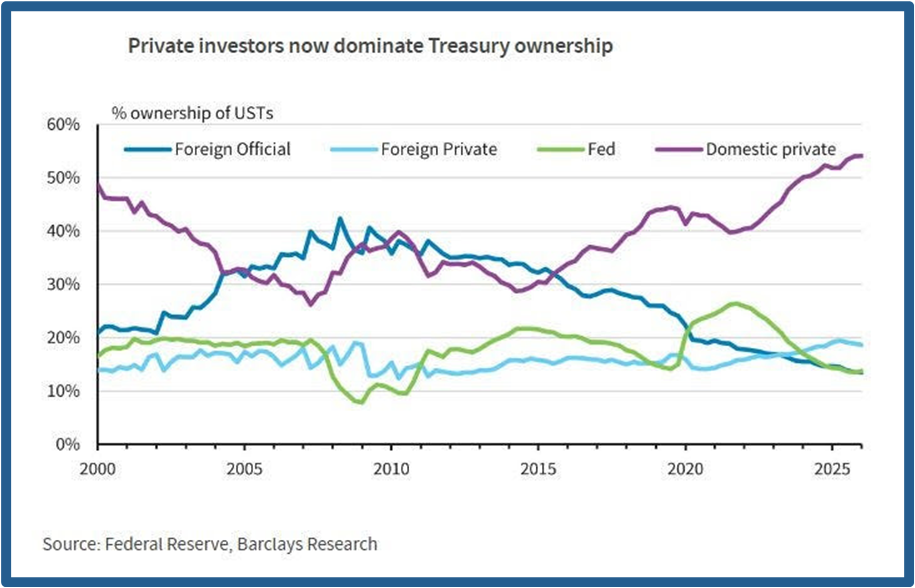
Hedge funds are the driving force behind the rise of private investors, and they employ a wide array of complex strategies using their Treasury positions, including strategies that involve the assumption of high amounts of leverage. Again – we do not know what specific level Treasury yields would have to get to in order to trigger a sudden tsunami of selling by these investors. But we can surmise that the danger is higher than it would be if those Treasuries were still sitting in the coffers of the world’s central banks, like they were a couple decades ago.
Risk Spreads are Widening
Remember credit default swaps? When the global financial crisis hit in the fall of 2008, arguably the one thing that nearly broke the back of the entire financial system was the massive amount of credit default swaps (CDSs) on the books of insurance giant AIG, which did not possess the resources to make good on all the claims against it. A CDS is an insurance policy, essentially, that compensates the holder in the event of a credit default by the institution that wrote the CDS. In other words, the price of a CDS will rise as the likelihood of a default increases.
With this in mind, consider SpaceX. The company that went public with an eye-popping valuation back in June has repeatedly come to the debt markets to raise additional funds (above and beyond what it took in from the equity IPO) for its AI buildout projects. Just weeks after going public, the company sought $25 billion from the corporate bond market. This past week, it came back for another $40 billion to buy Nvidia chips for growing its xAI platform. Investors have responded by buying lots and lots of SpaceX credit default swaps, sending them to record highs.
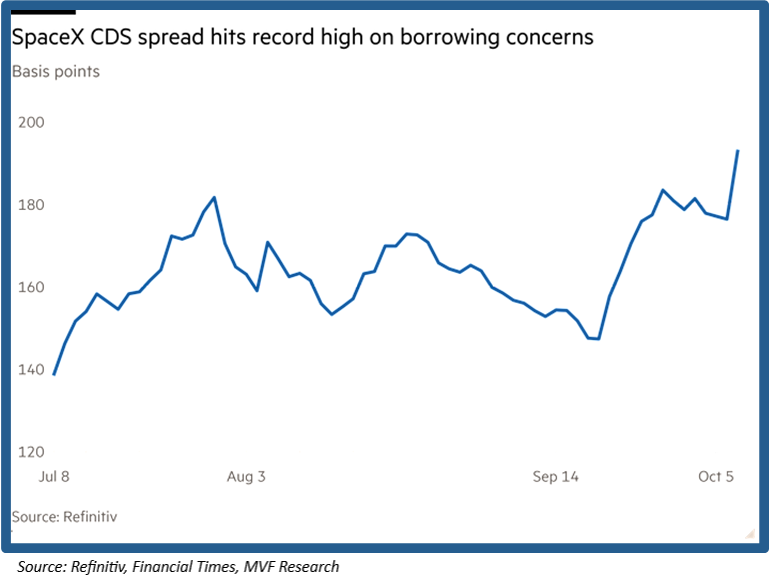
Other companies at the center of the AI narrative have also seen their CDS spreads widen in recent weeks. Remember that the heavy volume of AI-related corporate debt coming into the market is one of the key factors putting upward pressure on interest rates. And remember, as well, that back in 2007-08 CDS spreads were widening on institutions with direct exposure to subprime mortgages and their constellation of derivatives, even as the S&P 500 set a record high in October 2007 before beginning its long journey downwards.
Again, we can presume that there is a tripwire out there – at some level, the market is unable to digest any more AI debt without pushing yields to much higher levels throughout the global credit market, and then things all go south. Nobody knows what that level is. But the steady rise in credit default swap spreads tells us that the concerns are growing.