Meet Our Team
MV Weekly Market Flash: Our 2024 Outlook
MV Weekly Market Flash: New Year, New Jobs
MV Weekly Market Flash: Earnings Will Matter in 2024
MV Weekly Market Flash: A Very Good Inflation Number
MV Weekly Market Flash: The Pivot and the Puzzle
MV Weekly Market Flash: Last Big News Cycle for the Market in ’23
MV Weekly Market Flash: Growth Up, Inflation Down
MV Weekly Market Flash: The Story That Won’t Go Away
MV Weekly Market Flash: Japan, Still the Outlier After All These Years
Retirement Plan Limits 2024

MV Weekly Market Flash: Our 2024 Outlook

Read More From MV

As we normally do this time of the year, we are sharing with you our outlook for the economy and markets in 2024. For our clients, you will see this week’s commentary again as the executive summary of the Year Ahead report you will receive from us in a couple weeks or so from now. The Economy: Slower, But Still Growing The biggest economic story of 2023 was about something that didn’t happen. There was no recession in the United States or, for that matter, in the global economy at large. Against the predictions of most mainstream economists (ourselves included),...

Read More

MV Weekly Market Flash: New Year, New Jobs

Read More From MV

The first week of 2024 served up a bevy of data about the health of the US labor market. The main takeaway is that there are still jobs aplenty in our economy, nearly two years into the most dramatic monetary tightening program since the early 1980s. The December report published this morning by the Bureau of Labor Statistics showed 216,000 payroll additions last month, with the unemployment rate holding steady at 3.7 percent. Hourly wages rose by 0.4 percent, which is more than the 0.1 percent increase in the Consumer Price Index last month. In fact, hourly wages for the...

Read More

MV Weekly Market Flash: Earnings Will Matter in 2024

Read More From MV

It’s the last trading day in 2023, and it’s fair to say that the year turned out better than most of the pundits had predicted. Now, of course, the pundits are busy with their prognostications for the year ahead, including specific calls for US equities and other asset classes that will likely reach their sell-by date well ahead of December 2024. While it is always wise not to put much stock into a single prediction (you might as well go ahead and try to guess who will win the World Series next year), it can be useful to see the...

Read More

MV Weekly Market Flash: A Very Good Inflation Number

Read More From MV

As the year winds to a close, one of the big stories has been something that didn’t happen. That, of course, is the much-predicted Recession of 2023. It seems increasingly likely (though by no means a guarantee) that the economic downturn that did not happen this year will also not happen next year, putting Jay Powell in pole position to pull off what very few of his predecessors have – the “soft landing” at the end of a monetary tightening program. Here’s what that soft landing looks like in numbers: unemployment close to its recent lows at 3.7 percent, monthly...

Read More

MV Weekly Market Flash: The Pivot and the Puzzle

Read More From MV

For almost the entirety of the Fed’s monetary tightening program, the relationship between the central bank and the bond market has been like that of a mother insisting that her child eat his vegetables before he can have dessert. technocare.id smaiterpadurupa.sch.id The market wants to skip the vegetables and go straight to the cookie dough ice cream. immobilienheinrich.com Well, on Wednesday this week Fed chair Jay Powell looked at the kid’s plate, saw that it still had vegetables on it, but decided to bring out the ice cream anyway.Here Comes Santa Powell Yes, the pivot has arrived. Wednesday’s meeting was...

Read More

MV Weekly Market Flash: Last Big News Cycle for the Market in ’23

Read More From MV

There are still 23 days to go before calendar year 2023 rolls to an end. That leaves plenty of time for surprises of a good or not good variety to make themselves known to the market. In terms of things we do know, though, there really is just one more big news cycle to go, and it started today. Jobs, Jobs, Jobs No, the Bureau of Labor Statistics report this morning was not a barnstormer of the ilk we get sometimes, those surprises with half a million new jobs announced or the lowest unemployment rate since Lyndon Johnson was president....

Read More

MV Weekly Market Flash: Growth Up, Inflation Down

Read More From MV

Market pundits are fond of fairy tales, and perhaps none more so than the story of Goldilocks and the Three Bears. Goldilocks, of course, finds Papa Bear’s porridge too hot and Mama Bear’s too cold, before settling on Baby Bear’s as juuuuust right. As for porridge, so for the economy. We don’t want it running too hot (too much inflation) or too cold (recession). The Goldilocks Economy so beloved of financial news anchors is in that happy medium of growth that is moderate, but still positive. In another metaphor overused by the chattering class, it is the soft landing pulled...

Read More

MV Weekly Market Flash: The Story That Won’t Go Away

Read More From MV

It’s hard to believe that we are already here, a day away from Thanksgiving and thus the onset of the holiday season. Amid the frantic shopping and general merrymaking, this is the time when we look back on the big stories that collectively defined the year gone by. For those of us in the investment profession – and quite possibly for humanity as a whole – there is arguably no bigger story to define calendar year 2023 of the Common Era than that of artificial intelligence. Off To The Races The year opened with the realization that generative AI –...

Read More

MV Weekly Market Flash: Japan, Still the Outlier After All These Years

Read More From MV

The Japanese stock market is having itself a hot minute. The Nikkei 225 index, a benchmark for Japanese equities, is up nearly 30 percent so far this year, a standout performance among global markets and a sharp contrast to Asia’s other large economy, China, where stocks have been limping along in negative territory and getting little in the way of love from foreign investors. Long a byword for chronic economic sluggishness, Japan is back on the radar screen. Is there a strategic case to make here? A word or two of caution is in order, we believe. 33 Years And...

Read More

Retirement Plan Limits 2024

Read More From Retirement

Attached are the retirement plan limits for 2024.

Read More
MV Weekly Market Flash: Our 2024 Outlook

As we normally do this time of the year, we are sharing with you our outlook for the economy and markets in 2024. For our clients, you will see this week’s commentary again as the executive summary of the Year Ahead report you will receive from us in a couple weeks or so from now.

The Economy: Slower, But Still Growing

The biggest economic story of 2023 was about something that didn’t happen. There was no recession in the United States or, for that matter, in the global economy at large. Against the predictions of most mainstream economists (ourselves included), the American consumer put the pedal to the metal and spent, spent, spent. The jobs kept coming, month after month. Gross Domestic Product rose in the third quarter by an annualized rate of 4.9 percent, a pace way above historical trends. All this happened while interest rates kept going up and consumer prices kept going down. In the early days of 2024, it looks increasingly likely that the Fed’s monetary tightening program, begun nearly two years ago, will result in the often hoped-for but seldom achieved “soft landing.”

The economy’s better than expected situation could prove to be a tailwind for risk assets this year; however, there are plenty of potential challenges that could trip up performance as well. Businesses will have to deal with the twin obstacles of a likely slowing pace of demand, and of a loss of pricing power as inflation continues to recede. There is also the chance that China’s ongoing economic troubles reach a critical point this year. Finally, the geopolitical landscape looks to be anything but ordinary. More than two billion people in more than seventy countries are likely to cast ballots in nationwide elections this year, the most ever. Some of these will be highly consequential, and arguably none more so than our own presidential contest this November. Meanwhile, destructive wars rage on in Ukraine and the Middle East, and Taiwan is never far from the mix when the question of the next major flashpoint comes up. In short, there are reasons to be optimistic this year, and there are also reasons to be cautious.

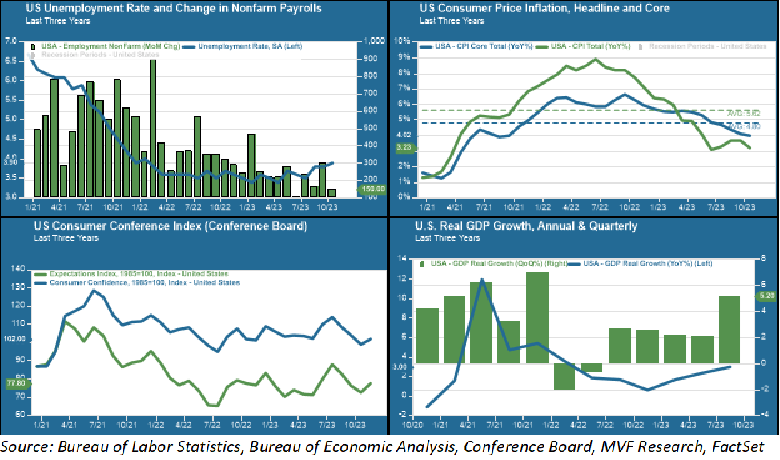
Here is how we see the year progressing (as always, please remember that these views are subject to change, based on imperfect and incomplete information, and may not correspond to actual outcomes). The economy will continue to grow, although at a slower rate than in 2023. In our opinion the two big macroeconomic stories of the year will be (a) the ongoing strength in the labor market, with the unemployment rate not likely to rise much above four percent; and (b) a continued decrease in consumer prices with the core Consumer Price Index falling below three percent by the end of the year. If this happens, it will constitute a textbook soft landing.

A soft landing, though preferable to a recession, is still what it says: soft, as in, not a period of robust growth. That will make for challenging conditions for businesses. A combination of softer demand and lower inflation will make it more difficult for businesses to achieve strong top line sales growth. With limited room for top line upside, these enterprises will need to find ways to achieve operating efficiencies to shore up their profit margins.

This spotlight on ways to improve profitability in the absence of strong sales will center around that other big story of 2023: artificial intelligence. Last year we witnessed an abject fascination by investors with the emergence of generative AI, popularized by accessible platforms like ChatGPT. This year, we expect the market will be a bit more discriminating about the hype, and more interested in the practical question of what generative AI can do for businesses as they attempt to grow profits in a slowing economy. This brings us to an analysis of what the equity market may have in store for us this year.

Equities: Proof Of Concept For AI

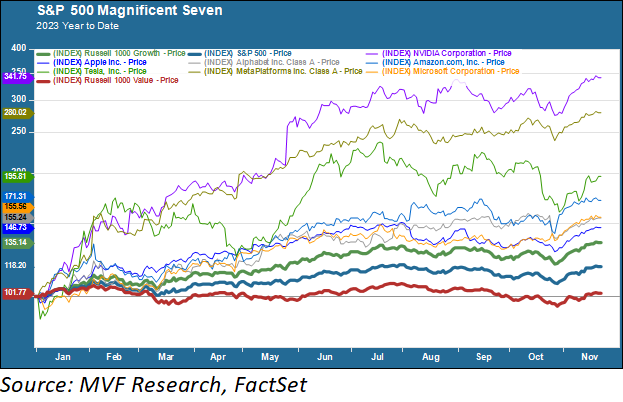
Equities in 2023 largely boiled down to seven words: Alphabet, Amazon, Apple, Meta, Microsoft, Nvidia and Tesla. These were the “Magnificent Seven” – the mega-cap tech stocks that for much of the year accounted for the entirety of the S&P 500’s price appreciation. The common thread between all these companies was artificial intelligence. Early last year, AI burst into the public imagination in a way that it had not previously, largely due to the arrival of generative AI platforms like ChatGPT and Dall-E with their user-friendly applications for the eerily prescient generation of textual and visual content. Investors quickly latched onto the Magnificent Seven as they all had features of GenAI at the core of their value propositions, with Microsoft and Nvidia perhaps the most prominent beneficiaries due to the former’s early embrace of GenAI progenitor OpenAI (not a publicly tradable company) and the latter’s dominant position as the supplier of the graphic processing units that enable GenAI applications to run.

We expect 2024 will be a different environment for AI, one less about hype and more about proof of concept. Beyond the novelty of AI-generated college essays or Impressionist paintings, the focus will shift to what businesses can do with GenAI to improve efficiencies and shore up profits. This is likely to be a particularly important issue this year as companies face a macro environment of cooling demand; operating efficiencies could potentially offset slower top line sales growth. But first, these businesses will have to show conclusively that these potential efficiencies exist.

Outside of large cap US equities, we do not see a compelling set of reasons to aggressively extend positioning. Our reasons for staying underweight in US small caps, non-US developed and emerging markets are structural, and nothing of recent note has changed our thinking.

Fixed Income: Less Drama, Please

If it took seven words to describe equity markets in 2023 (see above), it took just one word to encapsulate the bond market: Drama! Normally the most boring place in a diversified portfolio, offering safety and perhaps a predictable stream of income, the bond market was all over the place last year. The yield on the 10-year Treasury note, which plays a critically important role in investment markets as the “risk-free rate,” went up and down by greater magnitudes of percentage change than equities throughout much of the year. What made the bond market’s gyrations particularly puzzling was that the Fed was giving crystal-clear guidance throughout the year about its intentions with regard to interest rates. “Higher for longer” was the message reprised over and over again. In March, when an abrupt spate of insolvencies at several prominent banking institutions briefly raised fears of a full-scale banking crisis, the Fed continued to insist that it wasn’t done with raising rates. Yet the bond market immediately priced in a spate of rate cuts that were never going to happen. The same thing happened on two or three other occasions – traders furiously bought bonds and drove yields lower, the Fed came out and said “higher for longer” and yields spiked back up.

The central bank appears to be at the end of its monetary tightening program, and that could portend a somewhat calmer year ahead in fixed income. The short end of the yield curve in particular should not contain too many surprises. The Fed may cut rates a couple times, but then again it may not, depending on whether the economy is running hotter or colder than what is now the mainstream view of a middle-of-the-road soft landing. In the middle of the yield curve, assuming we manage to avoid a recession, the persistent inversion between 2-year and 10-year maturities should revert to a normal upward-sloping curve at some point, but how and when that happens is still very much up in the air. We think a wide range of yields from around three percent to five percent is appropriate for maturities within the 2-10 year band, and that should give investors a chance to lock in positive purchasing power, potentially for a number of years to come.

Concluding Thoughts

We always tell our clients that we are not in possession of a crystal ball any more than anyone else is. We do foresee a great deal of uncertainty around elections, particularly as our nation’s attention starts to fixate on the upcoming election during the primaries this spring and when the parties hold their conventions this summer. Markets may experience short-term fluctuations up or down during this period and in the immediate aftermath of November 5, but we believe it would be foolish for one to think that the timing, magnitude or direction of any such move could be capitalized on for tactical portfolio gains.

As has been the case in recent years, our asset allocation weights in 2024 will be divided between fixed income and equity asset classes for the most part representing liquid, relatively high-quality names (governments, agencies and investment grade corporates on the fixed income side, US large cap stocks for equity allocations). We do not see a compelling reason to venture into more exotic terrain as the year unfolds. Our approach to delivering long-term value for our clients is based on equities for growth, fixed income for safety, and keeping security selection decisions as simple as possible within the context of prudent diversification (Occam’s Razor – don’t make things any more complex than necessary to arrive at an informed conclusion). Our 2024 allocations will reflect an outlook based on a moderately positive environment for equities and more stable conditions for bonds than was the case in the past two years, implying incremental repositioning of fixed income away from short-term floating rate to intermediate fixed-coupon issues. As for all the things out there known and unknown that could trip up our assumptions, we believe we will be in a better position to countenance them if we refrain from making aggressive bets too far in one direction or another. We have little doubt that there will be surprises in store.

MV Weekly Market Flash: New Year, New Jobs

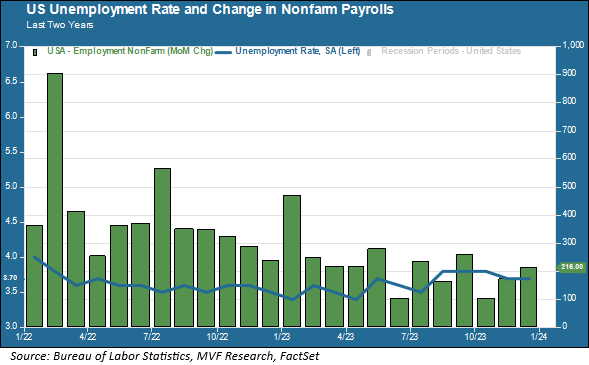
The first week of 2024 served up a bevy of data about the health of the US labor market. The main takeaway is that there are still jobs aplenty in our economy, nearly two years into the most dramatic monetary tightening program since the early 1980s. The December report published this morning by the Bureau of Labor Statistics showed 216,000 payroll additions last month, with the unemployment rate holding steady at 3.7 percent. Hourly wages rose by 0.4 percent, which is more than the 0.1 percent increase in the Consumer Price Index last month. In fact, hourly wages for the full year 2023 rose by 4.1 percent, while headline inflation for the same period was 3.1 percent (we use the headline inflation numbers here rather than the core number which the Fed focuses on, because for actual people the energy and food components excluded by the core index are rather important ones).

Coming In For A Soft Landing

There are several things worth noting about this chart. First, you can clearly see that fewer jobs were created last year than in 2022. That is, in fact, just about exactly what the Fed hoped would happen: a cooler jobs market but one still showing gains every month. Second, the unemployment rate remains below four percent. The current level of 3.7 percent is just a few ticks higher than the 3.4 percent level achieved back in April, which in turn represents the lowest rate of joblessness since 1968. The median unemployment rate for the US economy since 1950 is 5.5 percent.

At least for the moment, these jobs numbers add to the mounting evidence that the Fed has managed to engineer that fabled “soft landing” of economists’ dreams. At some point it may even sink into the sensibilities of disgruntled American citizens (only 14 percent of whom, according to a recent survey, think the economy is doing at all well) that things are actually okay. Yes, the price of eggs is higher than it was in 2019, but so are their incomes, as attested to by those BLS wage numbers. Inflation continues to trend lower, the recent holiday shopping season proved resilient, and 2024 appears to be starting off on the right foot. At least for now.

The Market’s Take

All well and good, one might say, but how will markets react? Don’t we have a “good news is bad news” problem in which better economic growth implies interest rates staying higher for longer and thus disrupts all those rate cut hopes that have kept stocks and bonds humming along so nicely for the past couple months? Perhaps, though it’s worth noting that US stocks are up this morning in the wake of the jobs report, reversing earlier declines in futures markets. The bond market does seem to be rethinking some of the exuberance that followed the most recent Fed policy meeting in December, but in our opinion that exuberance was never warranted in the first place. If the Fed does pull off the soft landing and we get through the tightening cycle with no recession, that should be favorable to risk asset performance this year. It’s early yet, and the first few days of the new year have not been particularly rosy for stocks (which is not necessarily surprising, given the barnstormer of a finish to 2023). But so far, so good as far as the economy goes. Next up: fourth quarter earnings. We’ll have more to say about the challenges companies will be facing this year in forthcoming commentaries.

MV Weekly Market Flash: Earnings Will Matter in 2024

It’s the last trading day in 2023, and it’s fair to say that the year turned out better than most of the pundits had predicted. Now, of course, the pundits are busy with their prognostications for the year ahead, including specific calls for US equities and other asset classes that will likely reach their sell-by date well ahead of December 2024. While it is always wise not to put much stock into a single prediction (you might as well go ahead and try to guess who will win the World Series next year), it can be useful to see the range of scenarios envisioned by the market pros. At least one of them, after all, is likely to be close to reality, from a combination of disciplined analytical reasoning and dumb luck.

So what do the experts see as they stare into their crystal balls? Well, JPMorgan Chase doesn’t expect to be popping any Champagne. Their call for the S&P 500 at 2024 year end is 4,200, about a 12 percent decline – yes, decline – from the 4,783 close on December 28. At the other end of the spectrum, Goldman Sachs predicts a market close of 5,100 a year from now, representing a tidy but not barnstorming gain of 6.7 percent from yesterday’s close. According to the FactSet data compilation from whence these estimates come, the median estimate from the pros is for the blue chip US equity benchmark to register a 6.0 percent gain next year. That’s a pretty safe call. Of course, a year ago those same mavens were predicting a troubled 2023 for US equities and look what we got instead – a nice little gain of 25 percent thanks to a combination of no recession, AI mania and Jay Powell’s Christmas present of a Fed pivot on December 13.

We generally refrain from putting a hard number out there ourselves, because in our experience even getting the fundamentals right (the economy, earnings, monetary policy) doesn’t ensure a predictable market outcome. And getting the fundamentals right is notoriously difficult, as most experts found out in 2023 (see: The Recession of 2023, inverted yield curve etc.). What we do think is going to matter a great deal next year, though, is corporate sales and earnings performance. Now, it may sound facile to state that “earnings will matter” – but much of the time they don’t matter much from a stock price performance standard; or they matter, but other things matter more to the collective mind of the market.

Next year, though, businesses will likely be facing two distinct challenges to their financial prospects. First, the economy is likely to be growing at a considerably slower pace than the roughly three percent real GDP growth in the cards for 2023. Slower end-user demand implies lighter sales volumes. Second, the continued good news in slowing inflation means weaker pricing power for businesses. When both volume and price are weaker, the logical outcome is…well, lower sales. Already, during the Q3 earnings season, we have seen consumer-facing companies lower their forward guidance in light of expected “macro uncertainty” – corporate earnings call-speak for weaker consumer demand.

Sell-side analysts have been taking note of the downbeat guidance. The consensus outlook for Q4 earnings per share growth, according to FactSet, is 1.38 percent. That is down from a consensus outlook of 8.08 percent as of September 30, a sizable decline. Much will depend on companies’ ability to employ productivity measures to improve profit margins. Improvement at operating profit levels can offset weakness in top line sales – but the efficiencies will have to come from somewhere. Maybe all that AI hype from this year can translate into tangible productivity – but that is still more conjecture than clearly demonstrated use cases.

So earnings will matter. We will leave you with that as our parting observation. Meanwhile, we wish all of you a very Happy New Year and a joyful and healthy start to the year ahead.

MV Weekly Market Flash: A Very Good Inflation Number

As the year winds to a close, one of the big stories has been something that didn’t happen. That, of course, is the much-predicted Recession of 2023. It seems increasingly likely (though by no means a guarantee) that the economic downturn that did not happen this year will also not happen next year, putting Jay Powell in pole position to pull off what very few of his predecessors have – the “soft landing” at the end of a monetary tightening program. Here’s what that soft landing looks like in numbers: unemployment close to its recent lows at 3.7 percent, monthly job creation at a modest but still positive rate, Q3 real gross domestic product growth at 4.9 percent (a pace not likely to be repeated any time soon) and a holiday shopping season that so far seems to be exceeding expectations.

The test for Powell and his Fed colleagues was to accomplish this while at the same time bringing inflation down. On that front, today’s Personal Consumption Expenditure report was one of the best inflation prints to date. The PCE is less well known than the Consumer Price index, but it is the measure the Fed pays closest attention to as a gauge of consumer price trends (as usual, the Fed focuses on core inflation without the volatile categories of food and energy). The annualized core PCE reading for November was 3.2 percent, the lowest level since May 2021.

Even better, the month-on-month change in the core PCE was just 0.06 percent, well below the 0.2 percent predicted by economists. The month-on-month number is important because it tells us what has been happening with prices most recently. The answer seems to be: not going up by very much. In fact, the headline PCE number (which includes food and energy) actually fell by minus 0.07 percent month-on-month, bringing annualized headline PCE down to 2.6 percent. If this trend continues, it might actually start registering with Americans dissatisfied about the economy that, well, things are not all that bad (according to a number of surveys, a healthy plurality of our fellow citizens are firmly convinced that we are already in a recession, all the evidence to the contrary notwithstanding).

We will get a more realistic read on overall economic growth when the Q4 GDP report comes out in late January. The 4.9 percent number for Q3 (based on the third revision) was driven by consumer spending and inventory investment, and the latter number in particular is not likely to put in another barnstormer in Q4. But economists have been slowly revising their assumptions upward over the course of the past several months, and the median Blue Chip Consensus estimate is now just around 1.2 percent. The GDPNow tracker run by the Atlanta Fed predicts that Q4 GDP will come in at 2.7 percent, largely due to an expected increase in private business investment.

There are still plenty of unknowns in the mix. One of the challenges, in fact, is how businesses will adjust to weaker pricing power as inflation continues to come down. This morning Nike, a useful benchmark for consumer discretionary trends, gave a downbeat estimate for future macro conditions as weaker demand and less ability to raise prices implies flat or negative sales growth. The company is focusing on cost controls and improved efficiencies to shore up profit margins in response to weaker sales.

Then again, a downbeat macro demand outlook may be the excuse the Fed needs for the rate cuts the market (and, as of last week’s FOMC meeting, the Fed itself) expects to see next year. If month-on-month inflation numbers continue coming in at or below 0.1 percent, as with today’s PCE report, the central bank will have some leeway to soften its interest rate policy without worrying about another spike in consumer prices. That would be about as smooth a soft landing as possible, were it to come to pass.

For those of you who are celebrating Christmas this weekend, may it be a very merry one full of joy and laughter with friends and loved ones.

MV Weekly Market Flash: The Pivot and the Puzzle

For almost the entirety of the Fed’s monetary tightening program, the relationship between the central bank and the bond market has been like that of a mother insisting that her child eat his vegetables before he can have dessert. technocare.id smaiterpadurupa.sch.id The market wants to skip the vegetables and go straight to the cookie dough ice cream. immobilienheinrich.com Well, on Wednesday this week Fed chair Jay Powell looked at the kid’s plate, saw that it still had vegetables on it, but decided to bring out the ice cream anyway.Here Comes Santa Powell

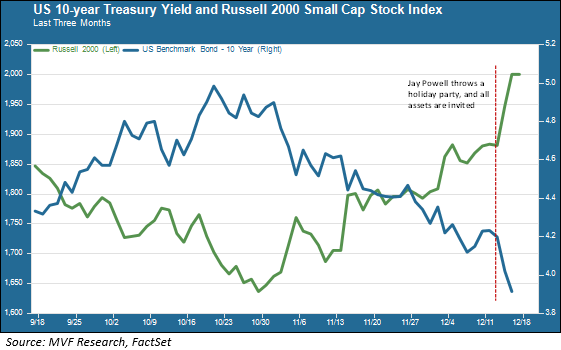
Yes, the pivot has arrived. Wednesday’s meeting was a “dot plot event” in which the members of the Federal Open Market Committee make their best guesses as to where key numbers in the economy will be for the next three years, including the Fed funds rate. These are the Summary Economic Projections. On Wednesday, bond investors skipped over every single estimate in the SEP to focus on one single collection of dots – those representing where the Fed funds rate will be in 2024. Lo and behold, the median estimate was 4.6 percent. Translated into market-speak, that suggests three rate cuts of 0.25 percent each are now the base case for the Fed’s planning purposes. Needless to say, the market was off and running for all manner of investable assets.

Game-Day Audibles

To say that the Fed’s pivot was unexpected would be an understatement. As recently as last week, Fed officials were hammering away at the same points they have been making for many months: the fight against inflation is far from over, and rates are going to stay higher for longer. In fact, with financial conditions having eased significantly over the course of the broad-based November rally, the thinking was that if the Fed pulled any surprises at all, they would be of the hawkish rather than the dovish variety.

So what changed? Not much seemed to be different in the rest of those SEP dot plots, representing Committee members’ guesses about the labor market, GDP growth or longer-term inflation, from what they were in September. There was one notable change, though. The inflation estimate for 2023, i.e. the year that ends in just 16 days, was lower than the September estimate. Part of that was due to a better than expected reading from the Personal Consumption Expenditures index a couple weeks ago. Part of it, though – and this was in Jay Powell’s own words at the post-meeting press conference – was a softer number from the Producer Price Index that came in the same day – Wednesday – as the FOMC meeting. In other words, according to Powell, a few Committee members came into work on Wednesday morning, read the PPI report, and promptly revised their inflation outlooks down. A game-day audible, so to speak. Sometimes those work. Sometimes they will seem in hindsight to have been misguided.

The Puzzle

So what does all this potentially mean for the markets? The sugar high won’t last forever, though we think it’s likelier than not to give an added boost to the positive seasonal vibes historically associated with December. The S&P 500 is just one or two good days away from surpassing its last record high, set on January 3, 2022. We will not be surprised to see the benchmark index close out the year in record territory.

Going into next year, though, the picture is a bit foggier. Both the stock market and the bond market have rallied strongly for seven weeks now. By some technical positioning measures they are at their most overbought levels in more than a decade. Weekly equity inflows are at their highest levels in two years. That could potentially lead to a pullback of sorts in January, and perhaps give investors pause to think through what all this really means.

For one thing, are those rate cuts actually going to happen, and if so, why? Bear in mind that the SEP numbers do not represent policy decisions; they are nothing more than best guesses and they are subject to change. Here’s the thing: the Fed will tend to be more aggressive about rate cuts when (a) inflation is convincingly under control; and (b) the risk of recession is high. Right now neither of those conditions apply. The November PPI number notwithstanding, core consumer inflation is still well above the Fed’s two percent target.

As for the broader economy, it is still growing, even if the pace is likely to slow considerably from the third quarter’s blistering 5.2 percent real growth rate. In other words, the evidence is not yet in that the economy needs even one, let alone three, rate cuts in 2024. The bond market, ahead of its skis as always, has already priced in not just three, but six rate cuts next year. Some caution is merited.

Then there is the added X-factor for 2024 in particular, which is that it is an election year, and the Fed as a rule errs on the side of caution when the political cauldron is aboil, so as not to invite accusations of favoring one side or the other.

All of this is to say that, while we will be perfectly pleased to see the end of the monetary tightening program, we remain considerably less convinced than Mr. Market that the days of easy money and good times for low-quality assets are back. 2024 is likely to have plenty of tricks up its sleeve.

MV Weekly Market Flash: Last Big News Cycle for the Market in ’23

There are still 23 days to go before calendar year 2023 rolls to an end. That leaves plenty of time for surprises of a good or not good variety to make themselves known to the market. In terms of things we do know, though, there really is just one more big news cycle to go, and it started today.

Jobs, Jobs, Jobs

No, the Bureau of Labor Statistics report this morning was not a barnstormer of the ilk we get sometimes, those surprises with half a million new jobs announced or the lowest unemployment rate since Lyndon Johnson was president. But still – here we are, twenty months into the most draconian monetary tightening program since the early 1980s, and the economy is still pumping out those jobs. 199,000 new payroll gains, to be precise, according to today’s BLS report. And, for good measure, the unemployment rate unexpectedly dropped again, from 3.9 percent to 3.7 percent (which by the way is only 0.3 percent higher than the 3.4 percent low for this cycle, which does in fact match the LBJ-era low). As always, there are various anomalies that skew the monthly numbers one way or another, a prominent one this time being the 30,000 auto industry workers who came back onto the job after the end of the recent UAW strike. But that was public knowledge ahead of this morning’s report, and the 199K was still 24,000 more than economists had predicted according to FactSet, a market research company.

Next Up, Inflation and the Fed

Two more big-ticket events will round out this news cycle: the Consumer Price Index report next Tuesday and then the Federal Open Market Committee decision about interest rates on Wednesday. For the CPI report, economists are looking for a month-to-month change of 0.3 percent in core inflation (i.e., excluding food and energy). That would translate to a year-on-year core inflation rate of 4.0 percent, which is still twice as high as the Fed’s two percent target. Investors would like to see the month-on-month number come in lower; the PCE inflation report that came out a couple weeks ago showed just a 0.16 percent month-on-month gain, which gets us closer to that two percent year-on-year number.

The Fed is likely to keep rates where they are. But what they say after the FOMC meeting matters a great deal, because once again the bond market has been merrily going its own way without listening to any Fed official who repeats the “higher for longer” mantra. As we have discussed in recent commentaries, the bond market sizzled through November as traders resurrected their persistent fantasy of successive rate cuts in 2024.

For the Bond Market, There’s Always a Pony Out Back

Current bond market levels indicate that investors have priced 1.25 percent worth of rate cuts into their outlook for 2024, a number we regard as sheer madness. Assuming a cut of 0.25 percent each time, that would mean the Fed would be cutting rates five times – five! – in a year when the economy is still growing (as far as we know now), inflation is still well above target, job growth is healthy even though off its highest levels and, to top it all off, 2024 is an election year in which the Fed is likely to be more cautious than usual in doing anything with interest rates that could be criticized as politically favorable to one side or the other (note to Fed: you’ll get criticized by the politicos no matter what you do, so just do the right thing).

Why does the bond market keep doing this? We have seen this “fight the Fed” mentality all throughout the rate tightening cycle. All the while, the Fed has meant it when it says “higher for longer.” Why is it going to be different this time? Spoiler alert: it likely won’t be different this time. Next week awaits.

MV Weekly Market Flash: Growth Up, Inflation Down

Market pundits are fond of fairy tales, and perhaps none more so than the story of Goldilocks and the Three Bears. Goldilocks, of course, finds Papa Bear’s porridge too hot and Mama Bear’s too cold, before settling on Baby Bear’s as juuuuust right. As for porridge, so for the economy. We don’t want it running too hot (too much inflation) or too cold (recession). The Goldilocks Economy so beloved of financial news anchors is in that happy medium of growth that is moderate, but still positive. In another metaphor overused by the chattering class, it is the soft landing pulled off by the Fed as it tries to thread the needle of a monetary tightening without driving the economy into the ground.

Approaching the Runway

The Fed has not yet stuck the landing, but the numbers are looking pretty good as the plane approaches. This week saw an upward revision of third quarter GDP real growth to 5.2 percent, while the latest inflation data in the form of the PCE report validated the continuing downward trend in consumer prices seen in the most recent Consumer Price Index release a couple weeks ago. Meanwhile the labor market is still growing, with a more moderate pace of monthly nonfarm payroll growth, and consumer confidence levels are reasonably stable from month to month. All this would seem to be about as Goldilocks as it gets.

Investors have taken notice. The S&P 500 closed out November with a gain of nearly nine percent, its best monthly performance since summer of 2022. The Nasdaq Composite did even better, coming in at 10.7 percent for the month on the back of yet another rally in the Magnificent Seven and its posse of tech / growth stock darlings. The Fed eased up on its hawkish-leading commentary from earlier in the fall, producing another outsize run-up in bond prices as yields plummeted. This sets the stage for (wait for it) yet another metaphor that Wall Street will never get tired of: a Santa Claus rally in December. Though maybe not starting today, if S&P futures are any indication of how the first day of the new month will play out (always subject to change throughout the day).

Some Caveats

We think overall conditions seem fairy supportive for a positive end to the year. As always, though, there are plenty of ways for things to turn pear shaped. Let’s start with the bond market, which is never too far away center stage in our analysis. The pattern of volatility that has been a constant theme of this year is still with us. In the most recent rally, the 10-year Treasury yield fell from five percent on October 19 to 4.27 percent earlier this week, a percentage change of 17 percent. This is the third big rally for bonds this year, following the misplaced enthusiasm about inflation at the beginning of the year and then the mini-crisis in the banking sector in March. It’s worth noting that on both previous occasions yields snapped back after the initial exuberance. Bond traders are once again pricing in rate cuts that the Fed insists are not up for discussion any time soon, so the happy vibes of the moment could face a reality check.

Then there is the persisting fact of the narrowness of gains in the equity market this year, dominated (as we discussed in some detail last week) by the small number of names able to tap into the general enthusiasm for artificial intelligence. That theme will get more scrutiny next year, leaving an open question as to where the big growth drivers will come from.

As for the economy, it mostly comes down to the US consumer. Strength in consumer spending has been the most important factor keeping the economy performing ahead of expectations this year, even in the face of all those interest rate hikes making credit more expensive. Will that strength carry into next year? Assuming that inflation continues its downward trend and the Fed really is done with its tightening, one could make a fairly good argument for yes. But it’s not a given. Nothing lasts forever, not even the prodigious might of the world’s consumer of last resort.

MV Weekly Market Flash: The Story That Won’t Go Away

It’s hard to believe that we are already here, a day away from Thanksgiving and thus the onset of the holiday season. Amid the frantic shopping and general merrymaking, this is the time when we look back on the big stories that collectively defined the year gone by. For those of us in the investment profession – and quite possibly for humanity as a whole – there is arguably no bigger story to define calendar year 2023 of the Common Era than that of artificial intelligence.

Off To The Races

The year opened with the realization that generative AI – applications that generate highly advanced written or visual content from just a few easy prompts – was now available to anyone with a standard-issue computer, phone or other smart device. In late 2022 a company called OpenAI had released a program called ChatGPT that bedazzled its early adopters with its ability to do, well, just about whatever a user asked it to do (and sometimes much more, as some journalists discovered somewhat uneasily in their encounters with the system).

Then OpenAI announced a partnership with Microsoft to build out commercial applications on top of generative AI capabilities. It wasn’t too long before the market figured out which companies had a good story to tell involving AI. Seven of them – Alphabet (Google), Amazon, Apple, Meta (Facebook), Microsoft, Nvidia and Tesla – became the single biggest force driving US equities throughout the year.

For much of the year, in fact, these seven companies were the only thing driving the market – had it not been for their existence, the S&P 500 would have been underwater for much of the first half of the year. The pace has shifted a bit since then, but the Magnificent Seven, as they inevitably came to be known, still account for just under 30 percent of the entire market capitalization of that index of 500-ish stocks.

The Good, The Bad…

As is often the case, observers continue to argue about whether the AI story is based on something substantial, or yet another in a never-ending parade of effervescent bubbles. Is generative AI the key to enhanced productivity, the one thing that has been missing from the economy in recent decades? Will it be something that helps more people do more things more effectively, or will it put people out of work as AI applications take over everything from the most mundane forms of labor to the rarefied reaches of elite white-collar professions? Does Artificial General Intelligence – the holy grail of AI in which machines can perform anything humans can, only much more effectively and without having to take lunch breaks or sick days – imply something even more dire for civilization than mere widespread unemployment?

These questions haven’t necessarily been at the forefront of investors’ minds as they bid up the likes of Microsoft and Nvidia – but boy howdy, have they been hotly debated in the halls of OpenAI, and this week we were treated to a full-on spectacle of how this has been playing out.

…And The Ugly

It would be hard to overstate just how many palms of the hand slapped how many foreheads last Friday evening, when the news surfaced that OpenAI’s board of directors had fired the company’s CEO, Sam Altman. Altman was, for all intents and purposes, the official public face of AI and thus the single human being on the planet to whom all turned for insights about the year’s number one story. The story played out like a soap opera, and anyone who follows the daily doings of the denizens of Silicon Valley would already be familiar with the many characters who rushed in to be a part of the story – big-name VCs, other tech titans, journalists and others who ply their trade in the silicon sandbox.

By the end of the weekend Altman announced he was taking his talents to Redmond to team up with OpenAI’s partner Microsoft. Then practically the entire staff of OpenAI threatened to quit and follow their leader up north – including (not making this up) the board member who led the original move to fire Altman. Now it appears that Altman will be returning to OpenAI. Maybe! Who knows anything, other than that this story has more chapters to be written.

The soap opera aspect, unsurprisingly, is what has dominated the news this week. But there is a very serious set of circumstances behind it, reflected in the peculiar organizational and governance structure of OpenAI that was a deliberate feature of its original blueprint. Should an organization in possession of intellectual property with so many far-reaching and as-yet unknown potential implications be dedicated to putting prudence ahead of profits? Or should it be yet another tech behemoth (the organization already had an imputed valuation of around $90 billion before the events of last Friday) focused only on scaling up, moving fast and breaking things? Sam Altman was moving in one direction. Other board members found that direction concerning. A public spectacle ensued, and while order may well be restored in the short run, the questions will go on. Whether AI will continue to be the front and center story in equity markets is unclear. What is quite clear is that it will not be exiting the stage any time soon as far as the economy, and society in general, are concerned.

As we get ready for the holidays, we want to wish each and every one of you a happy Thanksgiving, full of joy, love and laughter shared with your friends and loved ones. We are truly fortunate to be a part of your lives.

MV Weekly Market Flash: Japan, Still the Outlier After All These Years

The Japanese stock market is having itself a hot minute. The Nikkei 225 index, a benchmark for Japanese equities, is up nearly 30 percent so far this year, a standout performance among global markets and a sharp contrast to Asia’s other large economy, China, where stocks have been limping along in negative territory and getting little in the way of love from foreign investors. Long a byword for chronic economic sluggishness, Japan is back on the radar screen. Is there a strategic case to make here? A word or two of caution is in order, we believe.

33 Years And Counting

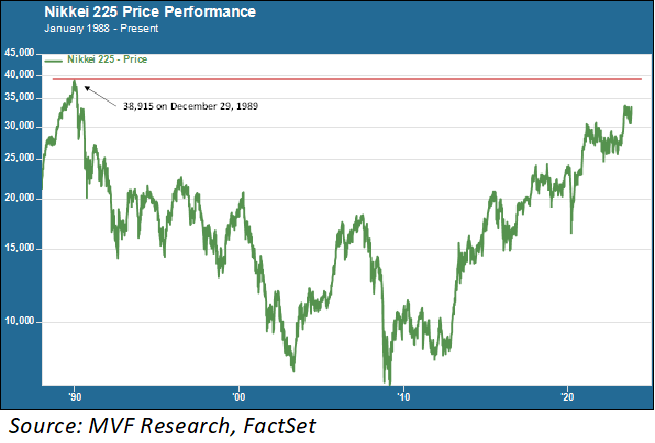
Those of us with a sufficiently long institutional memory know that Japan is the asterisk tacked onto the mantra that stocks go up in the long term. The Nikkei 225 reached an all-time peak of 38,915 on the last trading day of the year in 1989. Yes – the year that saw the fall of the Berlin Wall, Czechoslovakia’s Velvet Revolution and the birth of Taylor Swift, among other seismic world events, was also the last time the phrase “Japanese stocks closed at a record high” was ever uttered.

The Nikkei 225 today sits at 33,585. That is still around 14 percent below the 1989 record high, but it’s tantalizingly close, considering where the index has been for much of the intervening period, as the above chart shows. Foreign investors have been a big source of the market’s upward trend this year. Last week, in the wake of a broad global rally on the back of positive sentiment about the Fed and interest rates, Japanese stocks attracted some $7.4 billion from international buyers. Last month the Wall Street Journal called Japan “the most exciting equity market in the world.” Warren Buffett has been a fan of late. Is there enough juice left for a final surge to bridge the 14 percent deficit and set a new record high?

Going Its Own Way

We are not going to make bets on short-term prospects for the Nikkei – that’s not what we do. But when we consider the strategic case for a long-term position in Japanese equities, we do not see much evidence to support such a move. It is true that, after many years in which the economy flirted with chronic deflation, consumer prices have risen in the past couple years. The national consumer price index currently sits around 2.7 percent – low in comparison to recent inflation levels in Europe and North America, but much higher than the levels of the previous decade when it struggled to stay above zero.

But at the same time that inflation is above trend – and above the Bank of Japan’s target of two percent – the economy is stagnating. Real GDP growth for the third quarter fell by 2.1 percent, a larger decline than expected. Consumer spending is weak, as average domestic wages have not kept up with higher inflation. Capital investment by businesses was also negative. The outlook for improvement in key areas like consumer spending is fairly muted. Japan risks transitioning from one kind of malady – deflation – to another – that old 1970s-era ball and chain of stagflation.

The government recently announced a proposed fiscal stimulus program that could potentially run to about three percent of the country’s total GDP. That might or might not work – stimulus efforts in the past have had decidedly mixed results. But it comes at a very awkward time, because monetary policy has been delicately trying to go in the other direction – tightening (i.e., anti-stimulus) after years and years of one of the most aggressive monetary easing programs ever pursued by a central bank. In addition to being the sole remaining country with negative benchmark interest rates, the Bank of Japan exerts pressure on long-term maturities through a policy of yield curve control. It is trying to loosen this control, though the BoJ’s opaque pronouncements on the subject have tended to leave investors more confused than enlightened. Fiscal stimulus and a stagnating economy make the BoJ’s job even harder than it already was.

Japan has arguably done a more or less respectable job with its economic policies, going back to the “Abenomics” era of the early 2010s, in fighting against some deep-seated long-term problems, not the least of which is the demographic challenge of a declining working-age population (along with the intractable cultural resistance to increased immigration to offset demographic decline). But the problems are not going away any time soon. At some point, we imagine the Japanese stock market will claw its way back to that 1989 high point. But for long-term portfolio allocation, we remain unconvinced.

Retirement Plan Limits 2024

Attached are the retirement plan limits for 2024.

MV Financial

Meet Our Team

Smart Strategies.

Investment Advisor Company